Last updated: September 2026
Travel around Japan and you’ll see shrines and temples everywhere — often within a few minutes’ walk of each other. For a first-time visitor, it’s a natural question: is this a shrine, or a temple?
The basic answer:
Shrines belong to Shinto. Temples belong to Buddhism.
That said, Shinto and Buddhism have influenced each other for so long in Japan that some sites resist a clean answer just by looking at them. This guide covers the practical clues that work for most situations you’ll actually run into while traveling.
A Torii Gate Usually Means Shrine
One of the easiest clues for travelers is the torii gate — the freestanding gate that marks the entrance to a shrine and, traditionally, the boundary between ordinary and sacred space.
As a rule of thumb: a torii gate almost always means shrine.
There are exceptions — at sites with a long history of Shinto–Buddhist fusion, you can occasionally find a torii near or even within temple grounds. But as a fast, practical read while you’re out walking, "torii equals shrine" holds up well.
Temples Often Have a Sanmon Gate

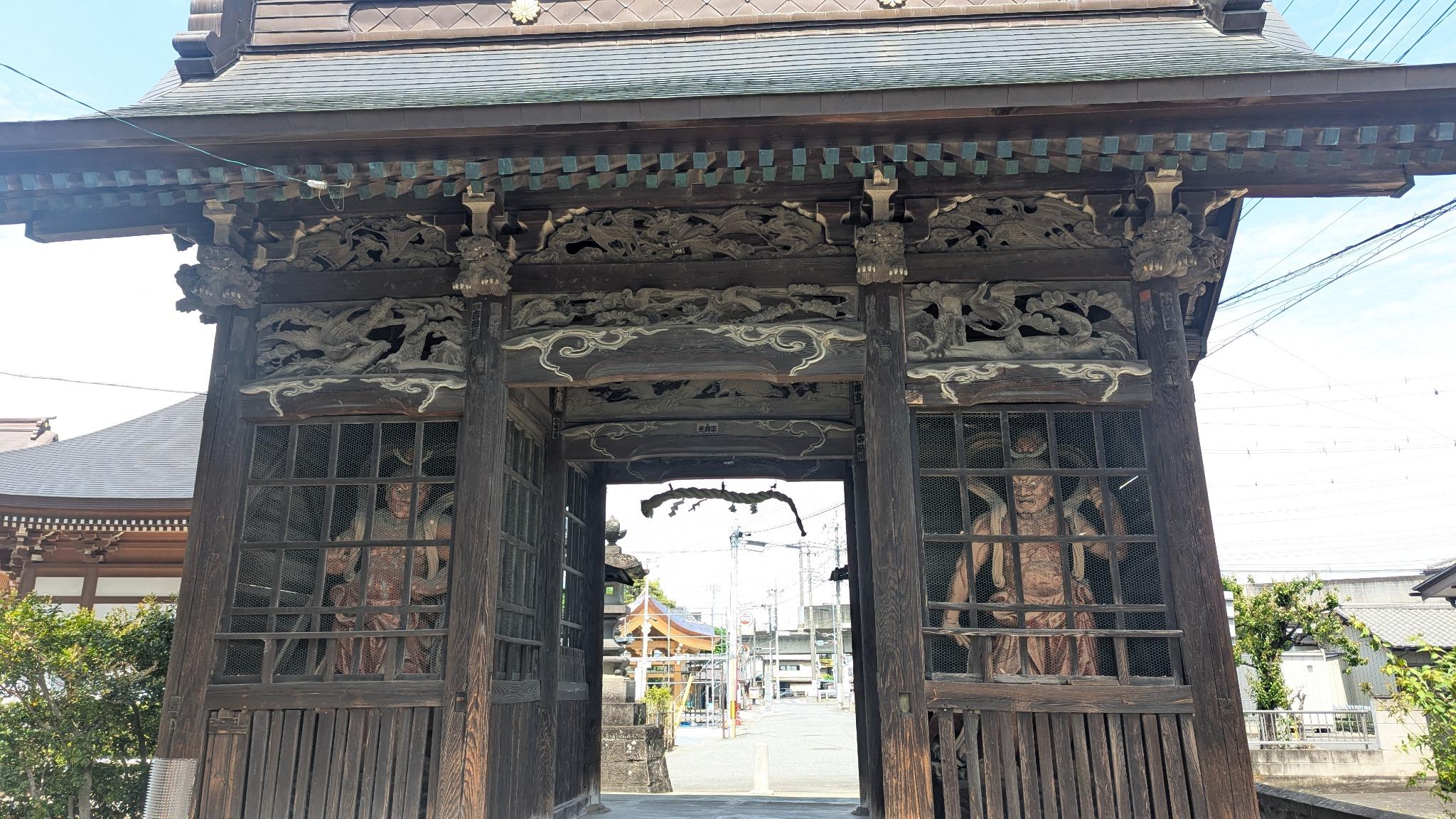
A temple gate with Nio guardian statues standing on either side.
Temples, meanwhile, often have their own kind of entrance gate: the sanmon — a large, roofed structure, sometimes flanked by a pair of Nio guardian statues.
Nio are fierce-looking guardian figures meant to protect the temple, and they’re one of the more visually striking clues a traveler can spot at a glance.
As a working rule:
- Torii gate → likely a shrine
- Large roofed gate with Nio statues → likely a temple
One caveat: shrines have their own grand gate styles too, such as the romon or shinmon. So a roofed gate on its own doesn’t automatically mean temple — it’s one clue among several, not a guarantee.
Statues vs. Mirrors: What’s Enshrined Inside
A prominently enshrined Buddhist image — a strong visual clue that you are at a temple.

What’s enshrined at the center of the site is another useful clue.
At a temple, the main hall (hondo) usually houses a Buddhist image — Shaka Nyorai, Amida Nyorai, Kannon Bosatsu, Jizo Bosatsu, and others are common.
At a shrine, the kami itself is often not represented as a human figure at all. Shinto has long used the mirror as a sacred symbol — though it’s typically kept out of view, deep within the main sanctuary, so you won’t necessarily see it as a visitor.
A simple version to remember:
- A Buddhist statue is prominently enshrined → likely a temple
- Shrines usually don’t display the kami as a figure at all
Shrine Staff vs. Temple Staff
The people working on-site are another clue.
When staffed, shrines are typically served by Shinto priests (kannushi), often in white robes and hakama trousers; some shrines also have miko — shrine maidens — assisting with rituals and the shrine office.
Temples are staffed by Buddhist monks, wearing robes and stoles (kesa), who lead chanting and ceremonies.
Keep in mind, though, that plenty of small shrines and temples aren’t staffed at all times — so an empty-looking site doesn’t tell you much on its own.
Kami vs. Buddha: Who’s Actually Being Prayed To
The deepest difference comes down to one question: who is being prayed to?
At a shrine, prayers go to kami — deities in the Shinto tradition. At a temple, prayers go to Buddhas and Bodhisattvas.
In short:
- Shrine → Kami
- Temple → Buddha / Bodhisattva
The Buildings Have Different Names, Too

A Buddhist temple hall, with the principal image visible inside.
Shrines and temples also use different terms for their central buildings.
At a shrine, you’ll typically see haiden (worship hall) and honden (main sanctuary). At a temple, the main hall is generally called the hondo.
Signage and maps often list these building names directly — worth a glance if you’re trying to work out what you’re looking at.
A Cemetery Usually Points to a Temple
In Japan, burial customs are closely tied to Buddhism, so cemeteries are commonly found on or near temple grounds. Shrines, by contrast, rarely have a general cemetery attached.
So: cemetery on-site → likely a temple. As with everything else on this list, it’s a strong indicator, not an absolute rule.
Prayer Style Is Different, Too
The way people pray differs between the two as well.
At a shrine, clapping is part of the standard prayer sequence. At a temple, worshippers usually don’t clap — prayer is done quietly, palms pressed together.
For travelers, this one’s easy to remember:
- Shrine → clapping is normal
- Temple → no clapping
Omamori, Omikuji, and Goshuin Exist at Both
Here’s where it gets a little more confusing: several traditions cross over between shrines and temples entirely.
Omamori (amulets), omikuji (paper fortunes), and goshuin (visit seals) are all available at both shrines and temples. So none of these tell you which one you’re at — having a goshuin available doesn’t mean "shrine," and selling omamori doesn’t mean "not a temple."
When in Doubt, Check the Name
If you’re still not sure, the site’s name itself is often a good clue.
Shrine names commonly include:
- Jinja
- Jingu
- Taisha
- Gu
Temple names commonly include:
- Tera / -dera
- In
As with the visual cues above, exceptions exist — Japan’s religious sites have long, complicated histories, and naming conventions aren’t airtight.
Why Some Places Are Genuinely Hard to Classify
Even after learning all of the above, you’ll eventually run into a place that still feels ambiguous. The reason usually comes down to one phenomenon: shinbutsu-shugo, the centuries-long blending of Shinto and Buddhist practice in Japan.
For much of Japanese history, it wasn’t unusual for a temple to sit right next to a shrine, for a Buddhist site to enshrine a Shinto kami, or for a shrine to carry visible Buddhist architectural influence. Shrines and temples are institutionally separate today, but older sites and historic religious complexes often still show traces of that long overlap — which is exactly why some of them resist a clean answer just from looking around.
The Quick Version
If you want the fastest possible read while traveling, these five points cover most situations:
- Torii gate → likely a shrine
- Large gate with Nio guardian statues → likely a temple
- A Buddhist statue is prominently enshrined → likely a temple
- Clapping is part of the prayer → shrine
- No clapping, just quiet hands pressed together → temple
There will always be exceptions, but for a first visit to Japan, this is more than enough to work with.
If You Genuinely Can’t Tell
Sometimes, even with all of this in mind, you still won’t be sure whether you’re standing at a shrine or a temple.
That’s fine. You don’t have to force a classification.
A quiet moment with your hands pressed together works as a respectful prayer either way — and since shrines typically involve clapping while temples don’t, defaulting to the quieter, no-clap version is a safe choice if you’re unsure. If there’s posted guidance for visitors, follow that instead.
What matters isn’t correctly identifying the site. It’s treating the place with respect.
Knowing the Difference Opens Up More to See
Shrines and temples are both deeply woven into Japan’s history and culture. Once you know the basic differences, small details start to make sense — why a torii stands where it does, why a statue sits at the center of one hall and not another, why clapping happens at one site and not the next.
But the goal was never to sort everything into tidy categories. Shinto and Buddhism coexisted and shaped each other for centuries in Japan, and that shared history is part of what makes these places worth visiting in the first place.
The short version: shrines and temples are different — but for most of Japanese history, they were never all that far apart. That’s really all you need to carry with you.
Author’s Note
This guide covers general visual and practical cues for distinguishing Shinto shrines from Buddhist temples in Japan. Exceptions exist at many historic sites due to centuries of Shinto–Buddhist syncretism (shinbutsu-shugo) — where on-site information is available, it should take priority over any general guide.
Japanese travel notes: More firsthand shrine visits and original Japanese-language articles are available on note.