Last updated: September 2026
Riding Tokyo’s subways and trains, it’s possible to trace the trail of a warrior who died more than a thousand years ago.
His name was Taira no Masakado.
In the 10th century, he built up power in the Kanto region and rose up against the imperial court. The revolt was crushed, and Masakado was killed. Under normal circumstances, that would be where the story ends.
Masakado’s story didn’t end there.
His severed head, the stories say, flew back from Kyoto to Kanto on its own. After death, his spirit was said to bring curses on those who wronged him. Mistreat the sites where he was enshrined, and misfortune would follow — even, according to legend, for the very people who had defeated him.
These stories spread across Tokyo over the centuries. And in a stranger twist still, the same feared spirit that inspired all this dread eventually came to be worshipped as a protector.
This guide follows five sites, in this order:
Kabuto Shrine → Masakado Tsuka → Kanda Myojin → the area around Tsukudo Hachiman Shrine → Yoroi Shrine
— moving from Nihonbashi Kabuto-cho through Otemachi, Ochanomizu, Iidabashi, and finally to Kita-Shinjuku, tracing how a defeated warrior went from feared spirit, to appeased ghost, to guardian deity.
Route at a Glance
Order Site Nearest Station What You’ll See
1
Kabuto Shrine
Kayabacho
An old warrior legend inside a modern financial district
2
Masakado Tsuka
Otemachi
A burial mound, curse legends, and a taboo against disturbing it
3
Kanda Myojin
Shin-Ochanomizu / Ochanomizu
A feared spirit worshipped as a guardian deity
4
Area around Tsukudo Hachiman Shrine
Iidabashi
The memory of a shrine that once stood nearby, dedicated to Masakado
5
Yoroi Shrine
Okubo / Higashi-Nakano
A legend claiming even Masakado’s enemies feared his spirit
Visiting all five sites at a relaxed pace takes roughly 4–5 hours, plus time for meals or detours. There’s no mountain hiking involved, but expect a fair amount of walking through the city.
Who Was Taira no Masakado?
Taira no Masakado was a warrior who built power across the Kanto region during the mid-Heian period. He eventually rebelled against the imperial court, reportedly declaring himself a new emperor, or "Shinno."
His power didn’t last. Masakado was defeated in battle and killed. His severed head, according to tradition, was sent to Kyoto and put on public display.
This is where the line between history and legend starts to blur. The displayed head, the stories say, opened its eyes. It tried to fly home. And it made its way back to the east.
Today, the legend surrounding Masakado Tsuka still holds that his head flew back to the Kanto region.
There’s the historical Masakado, and there’s the Masakado of legend that emerged after his death. This guide traces what happens where those two versions overlap — a phenomenon best described as "Masakado worship."
1. Kabuto Shrine: A Warrior Legend at the Heart of the Financial District

Kabuto Shrine in Nihonbashi Kabuto-cho, surrounded by the modern financial district.
The pilgrimage begins in Nihonbashi Kabuto-cho, right next to the Tokyo Stock Exchange.
A small shrine sits here: Kabuto Shrine (Kabuto Jinja). The surroundings are unmistakably modern Tokyo — office towers, securities firms, financial institutions — with a torii gate and a small shrine hall tucked in among them.
The grounds include a rock known as Kabuto-iwa ("helmet rock"). According to the Chuo City tourism association, the legend holds that the warrior Minamoto no Yoshiie buried a helmet here upon returning triumphant from a campaign in the east — and that this rock is the origin of the name "Kabuto-cho."
A separate legend connects the name to Masakado’s helmet instead. Worth being careful here: it can’t be stated as fact that Kabuto-cho takes its name specifically from Masakado’s helmet.
What’s genuinely interesting is something else: this single spot holds overlapping memories from different eras — Minamoto no Yoshiie, Taira no Masakado, a helmet, medieval warriors, and Tokyo’s modern financial district, all layered onto the same small plot of land.
Tokyo’s transformation into a modern city never fully erased its older legends. New neighborhoods were simply built on top of them. Kabuto Shrine makes a fitting starting point for that idea.
Access: 1-12 Nihonbashi-Kabutocho, Chuo City, Tokyo. Reachable from Kayabacho Station on the Tokyo Metro Hibiya and Tozai Lines.
From here to Masakado Tsuka: Kayabacho → Tozai Line → Otemachi.
2. Masakado Tsuka: The Place You’re Not Supposed to Disturb

Masakado Tsuka: a small memorial space preserved amid the high-rise offices of Otemachi.

The stone monument at Masakado Tsuka, where offerings and prayers continue today.
Arrive in Otemachi and the scenery turns even more modern: high-rise towers, banks, corporate headquarters — one of Japan’s most prominent business districts.
In the middle of it, a small memorial space appears without warning: Masakado Tsuka, the burial mound associated with Masakado.
There’s no grand shrine here, no large torii gate — just a stone marker and a quiet space for remembrance. And yet the place carries an unusual presence. Compared to the scale of the buildings around it, it’s tiny. Somehow, it feels cut off from the pace of the city surrounding it.
"Disturb It, and Misfortune Follows"
What made Masakado Tsuka famous is its curse legend.
Try to remove the mound, the stories say, and misfortune follows. Construction work triggers accidents. Everyone involved suffers some kind of calamity. These stories have circulated for generations.
Official visitor information for the site notes that around the 13th century, when the mound fell into disrepair, tradition holds that Masakado’s spirit brought misfortune on the people of Edo. The mound as it exists today has been preserved through events including reconstruction efforts by the Ministry of Finance after the 1923 Great Kanto Earthquake.
None of this proves that accidents or deaths were actually caused by a curse — that distinction matters. This guide treats historical events and the urban legends that grew around them as two separate things.
That doesn’t make the legend meaningless, though. What matters more is this: people never simply dismissed the possibility.
Feared Enough to Be Treated With Care
The actual site isn’t a horror-movie setting. Flowers are offered. The grounds are well kept. People stop to pray.
It isn’t unusual to see office workers from Otemachi pause here on their way to or from work.
This is the idea at the center of this whole guide: it isn’t a matter of fearing something and pushing it away. Something powerful enough to be frightening gets treated with unusual care instead. Fear and reverence exist here side by side.
Keep that in mind, because it will make the next stop — Kanda Myojin — look very different.
Access: 1-2-1 Otemachi, Chiyoda City, Tokyo. Right outside Exit C5 of Otemachi Station.
From here to Kanda Myojin: Otemachi → Chiyoda Line → Shin-Ochanomizu. Kanda Myojin is about a 5-minute walk from Shin-Ochanomizu Station.
3. Kanda Myojin: Where a Vengeful Spirit Became a Guardian Deity

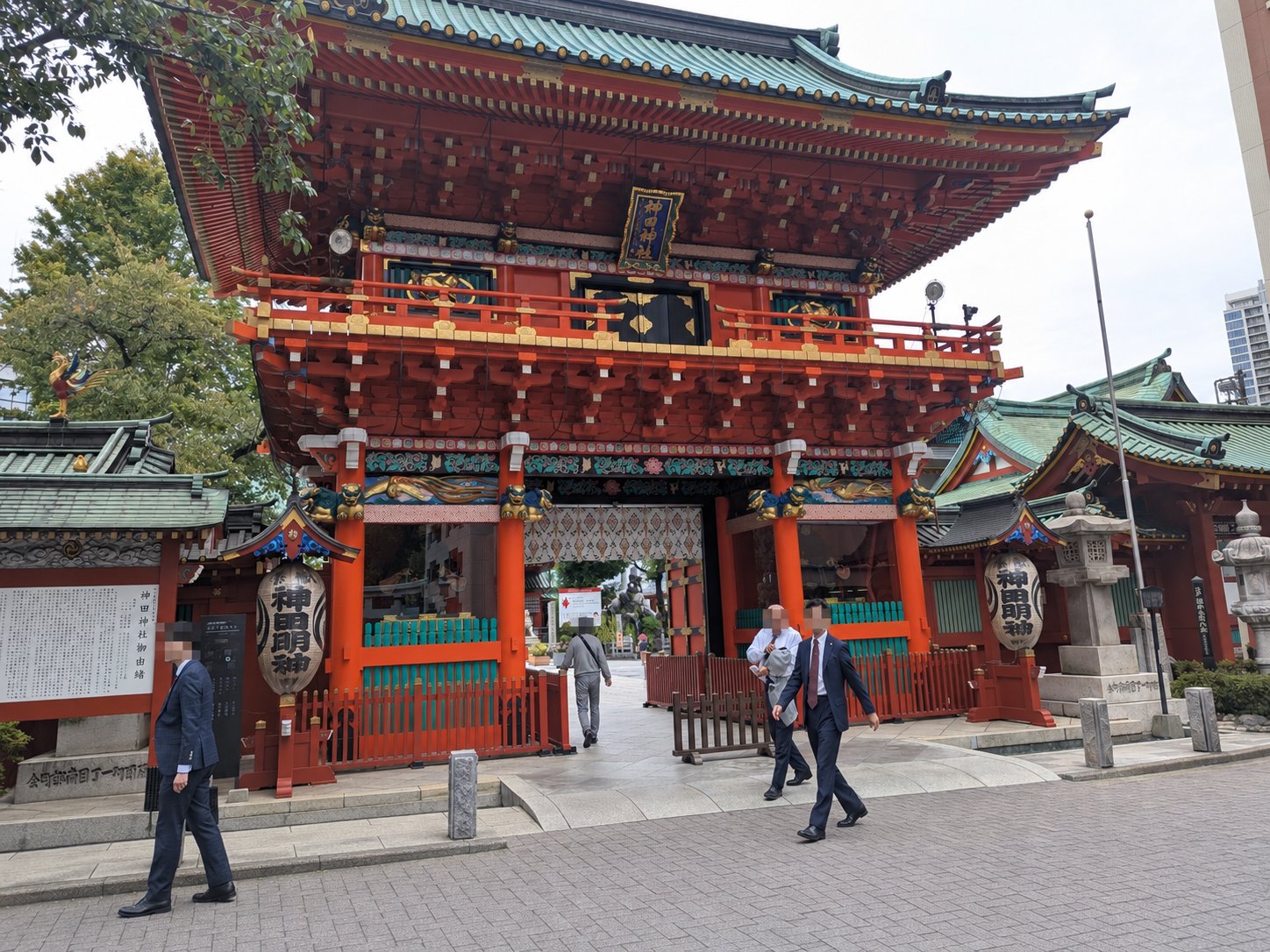
The vivid Zuishinmon gate of Kanda Myojin. Faces of visitors have been pixelated for privacy.

Kanda Myojin’s main shrine building, where Taira no Masakado is enshrined as one of the principal kami. Faces have been pixelated for privacy.

A komainu guardian at Kanda Myojin. Faces of nearby visitors have been pixelated for privacy.
The atmosphere shifts completely between Masakado Tsuka and Kanda Myojin.
A massive vermilion Zuishinmon gate. An ornate shrine hall. Crowds of visitors. Close to Akihabara, the shrine carries a genuine sense of energy typical of modern Tokyo.
And here, the same Masakado who was just discussed in terms of curses is enshrined as one of the shrine’s principal deities.
Kanda Myojin enshrines three kami: Onamuchi no Mikoto, Sukunahikona no Mikoto, and Taira no Masakado no Mikoto.
Why Enshrine a Feared Enemy of the Court?
Masakado rebelled against the imperial court and was defeated. After his death, he was feared as a vengeful spirit believed capable of bringing disaster.
And yet, rather than being erased from memory, he was enshrined.
If a spirit holds real power, the reasoning goes, the answer isn’t to try to eliminate it — it’s to honor it properly. Calm its anger. And, over time, redirect that power toward protection instead.
If Masakado Tsuka is where you see "Masakado, the feared," Kanda Myojin is where you see "Masakado, who became a guardian."
Are a Curse and a Blessing Really Opposites?
For visitors from outside Japan, this is one of the more genuinely interesting aspects of Japanese belief.
A cursed spirit and a protective deity look, on the surface, like complete opposites. But in Japanese religious tradition, that opposition isn’t always so clean.
A spirit is feared because it’s powerful. Precisely because it’s powerful enough to be frightening, it gets enshrined properly. Through that ongoing reverence, its power is calmed — and redirected toward protecting people instead.
In other words: a curse and a blessing can be understood as two faces of the same overwhelming power. Masakado worship offers a real, present-day example of that idea, right in the middle of modern Tokyo.
Access: 2-16-2 Sotokanda, Chiyoda City, Tokyo. According to the shrine’s official information, it’s a 5-minute walk from JR Ochanomizu Station, a 5-minute walk from Shin-Ochanomizu Station, a 5-minute walk from Suehirocho Station, or a 7-minute walk from Akihabara Station.
From here to the next stop: JR Chuo-Sobu Line, Ochanomizu → Iidabashi.
4. Around Tsukudo Hachiman Shrine: Where the Memory of "Chikubi Myojin" Lingers

Tsukudo Hachiman Shrine today. The shrine itself is not dedicated to Masakado; the connection comes from Tsukudo Myojin, which once stood nearby.

The stone steps leading up toward Tsukudo Hachiman Shrine in Iidabashi.
From Iidabashi Station, a short climb up a slope leads to Tsukudo Hachiman Shrine.
This stop works a little differently from the rest of the route. Tsukudo Hachiman Shrine itself is not a shrine dedicated to Masakado. Its enshrined deities today are Emperor Ojin, Empress Jingu, and Emperor Chuai — a shrine within the Hachiman tradition.
So why does it appear on a Masakado pilgrimage at all?
The "Bloody Head Deity"
The reason lies in what once stood nearby: Tsukudo Myojin.
Tsukudo Shrine, now located in Kudan-Kita, traces its origins to a shrine called Tsukudo Myojin, said to have enshrined Masakado starting in 940 CE. Over the centuries, the shrine relocated more than once — and during the Edo period, it stood near what is now Tsukudo Hachiman Shrine. Today, Masakado is enshrined at Tsukudo Shrine as a secondary deity.
According to tradition, this older shrine came to be known by an unsettling nickname: a nickname meaning roughly "Bloody Head Deity" (Chikubi Myojin) — a reference to its association with Masakado’s severed head.
If you visit Tsukudo Hachiman Shrine today looking for direct traces of Masakado, you won’t find much — and that’s expected. The shrine dedicated to him has since moved elsewhere.
What remains is the memory of the land itself: a shrine can relocate, but the association with a place tends to linger. This stop is a reminder that the Masakado legend was never confined to a single location — it scattered across the city.
Access: Tsukudo Hachiman Shrine, 2-1 Tsukudo Hachimancho, Shinjuku City, Tokyo. About a 6-minute walk from Iidabashi Station. (To visit Tsukudo Shrine itself, it’s about a 2-minute walk from Kudanshita Station.)
From here to the next stop: JR Chuo-Sobu Line, Iidabashi → Okubo.
5. Yoroi Shrine: Where Even Masakado’s Enemies Feared Him

The entrance to Yoroi Shrine in Kita-Shinjuku, a quiet residential setting far removed from Otemachi.

Yoroi Shrine’s main hall, associated with the legend of Masakado’s buried armor.
The final stop is Yoroi Shrine (Yoroi Jinja), tucked into a quiet residential neighborhood in Kita-Shinjuku.
Compared to Otemachi or Kanda, this is a different Tokyo entirely — calm residential streets, and modest, unassuming shrine grounds.
But this stop holds one of the most compelling Masakado legends on the entire route. According to the shrine’s own official information, Yoroi Shrine ("Armor Shrine") is associated with a legend that Masakado’s armor is buried on the grounds.
The Spirit That Even the Victor Feared
Yoroi Shrine’s legend involves Fujiwara no Hidesato, the warrior credited with defeating Masakado.
According to tradition, Hidesato later suffered from illness — or, in some tellings, feared retribution from Masakado’s spirit — and buried Masakado’s armor here as an act of appeasement.
This, too, is legend rather than confirmed history. But as a story, it matters. It implies something unusual: Masakado wasn’t only feared by the people who had supported him.
Battles have winners and losers. But after death, that relationship can flip. Masakado lost. And yet, according to legend, his spiritual power remained strong enough that even the man who defeated him couldn’t simply ignore it.
It’s a fitting place to end this route.
Access: 3-16-18 Kita-Shinjuku, Shinjuku City, Tokyo. According to the shrine’s own information, about 11 minutes on foot from JR Okubo Station, or 14 minutes from JR/Toei Oedo Line Higashi-Nakano Station.
Why This Particular Order?
The order above isn’t chronological — it’s designed for efficient walking around Tokyo.
Kabuto Shrine (Kayabacho) ↓ Tozai LineMasakado Tsuka (Otemachi) ↓ Chiyoda LineKanda Myojin (Shin-Ochanomizu) ↓ JR Chuo-Sobu LineTsukudo Hachiman Shrine (Iidabashi) ↓ JR Chuo-Sobu LineYoroi Shrine (Okubo)
This moves generally from east Tokyo to west, without much backtracking. For anyone actually walking this route, that matters more than following the legend in its original chronological order.
What Five Sites Reveal
The order above was chosen for transit efficiency. But laying the five sites out by meaning afterward reveals something else:
- Masakado Tsuka → curse and taboo
- Kanda Myojin → appeasement and guardianship
- Around Tsukudo Hachiman Shrine → the memory of the head legend, carried across a relocated shrine
- Yoroi Shrine → a legend of fear extending even to Masakado’s enemies
- Kabuto Shrine / Kabuto-cho → an old warrior legend layered onto a modern financial district
Masakado’s memory was never contained in a single grave or a single shrine. It scattered across Tokyo — as a head, as armor, as a helmet, as a curse, as a deity, and as a place name — taking on a different form at each location.
The Invisible Layer Beneath Tokyo
Tokyo is one of the world’s great modern cities: skyscrapers, subways, financial districts, offices, technology.
And underneath all of it, fear and prayer directed at a man who died over a thousand years ago still linger.
Masakado Tsuka sits in Otemachi, one of Japan’s most important business districts. Kanda Myojin sits right next to Akihabara. Kabuto Shrine sits beside the Tokyo Stock Exchange.
Old belief and the modern city aren’t separate worlds here. They occupy the exact same ground. Tokyo’s interest lies less in the fact that old things vanished, and more in the fact that old memory continues to sit directly beneath the new city, layer on layer.
This Isn’t a Horror Tour
This guide uses words like curse, vengeful spirit, and severed head more than most of the shrine guides on this site. But collecting scary stories was never the point.
What’s genuinely interesting is this: why did people take something they feared and turn it into an object of worship?
Fear. Appeasement. Reverence. Belief. Protection. In the story of Masakado, all of it connects into a single thread.
How This Differs From Other Shrine Guides on This Site
Elsewhere on this site, the focus has largely been on the relationship between a shrine and its land. At Haruna Shrine: rock, water, waterfall, and forest. At Myogi Shrine: the sensation of climbing toward an overwhelming mountain. At Ikaho Shrine: a hot spring town and its 365 stone steps.
This guide is different. The center of gravity here isn’t nature.
It’s death — and the fear, memory, curse, appeasement, belief, and guardianship that grew out of it.
Same basic subject — Japanese shrines — but this guide approaches it from a completely different angle. That difference is exactly what makes it worth including.
Practical Route Notes
- Time needed: About 4–5 hours for all five sites; half a day to a full day with meals or detours.
- Start: Kayabacho Station.
- End: Okubo or Higashi-Nakano Station.
- Main transit lines: Tokyo Metro Tozai Line, Tokyo Metro Chiyoda Line, JR Chuo-Sobu Line (local).
- Walkability: Mostly flat urban walking, though the area around Tsukudo Hachiman Shrine involves some slopes and steps.
- IC card: A Suica or Pasmo card makes getting around considerably easier.
- Photography: Be mindful of other visitors, especially anyone praying.
- On Masakado Tsuka specifically: This remains an active site of remembrance and belief today — not simply a "cursed tourist spot." Treat it as a place of prayer.
Final Thoughts
Taira no Masakado was a warrior defeated in the 10th century. And yet, more than a thousand years later, his trail can still be followed across modern Tokyo — through a financial district, a cluster of skyscrapers, a major shrine, a hilltop in Iidabashi, and a quiet neighborhood in Kita-Shinjuku.
Different places. The same memory running through all of them: rebel, defeated warrior, vengeful spirit, source of curses, and finally, protector of the people.
Fear became reverence. Reverence became belief. And a curse became protection.
Walking the places connected to Masakado isn’t just a history tour. It’s also a way of seeing how people in Japan have confronted frightening power, and folded it into belief rather than simply rejecting it.
Beneath Tokyo’s skyscrapers and subway lines, another Tokyo — one that’s been building for over a thousand years — still runs directly underneath.
Author’s Note
This guide is based on firsthand visits to the sites associated with Taira no Masakado. Stories involving curses, vengeful spirits, severed heads, armor, and helmets combine elements that can be verified in historical records with traditions that developed later as legend and urban lore. Wherever possible, this guide distinguishes between the two rather than presenting legend as established fact. The connection between Tsukudo Hachiman Shrine and "Chikubi Myojin" is presented specifically as a legacy of Tsukudo Shrine — the shrine that has since relocated to Kudan-Kita — rather than as a claim about Tsukudo Hachiman Shrine itself.
Japanese travel notes: More firsthand shrine visits and original Japanese-language articles are available on note.
Response
[…] This pattern shows up again and again across Tokyo’s shrines and temples. For a deeper dive into this theme, see Chasing Masakado Through Tokyo. […]