Last updated: September 2026
Ikaho Onsen is one of Gunma’s best-known hot spring towns. At its center is a long stone stairway lined with inns, souvenir shops, restaurants, and old buildings — the ishidan-gai, or "stone-step street."
Most visitors to Ikaho walk this stairway first. But it isn’t just a scenic backdrop for the town. Climb it step by step, and the atmosphere shifts gradually until, at the very top, you reach Ikaho Shrine.
The appeal of Ikaho Shrine isn’t a large or ornate shrine hall. It’s the experience of walking through an entire hot spring town and arriving at a shrine only at the very end of that walk.

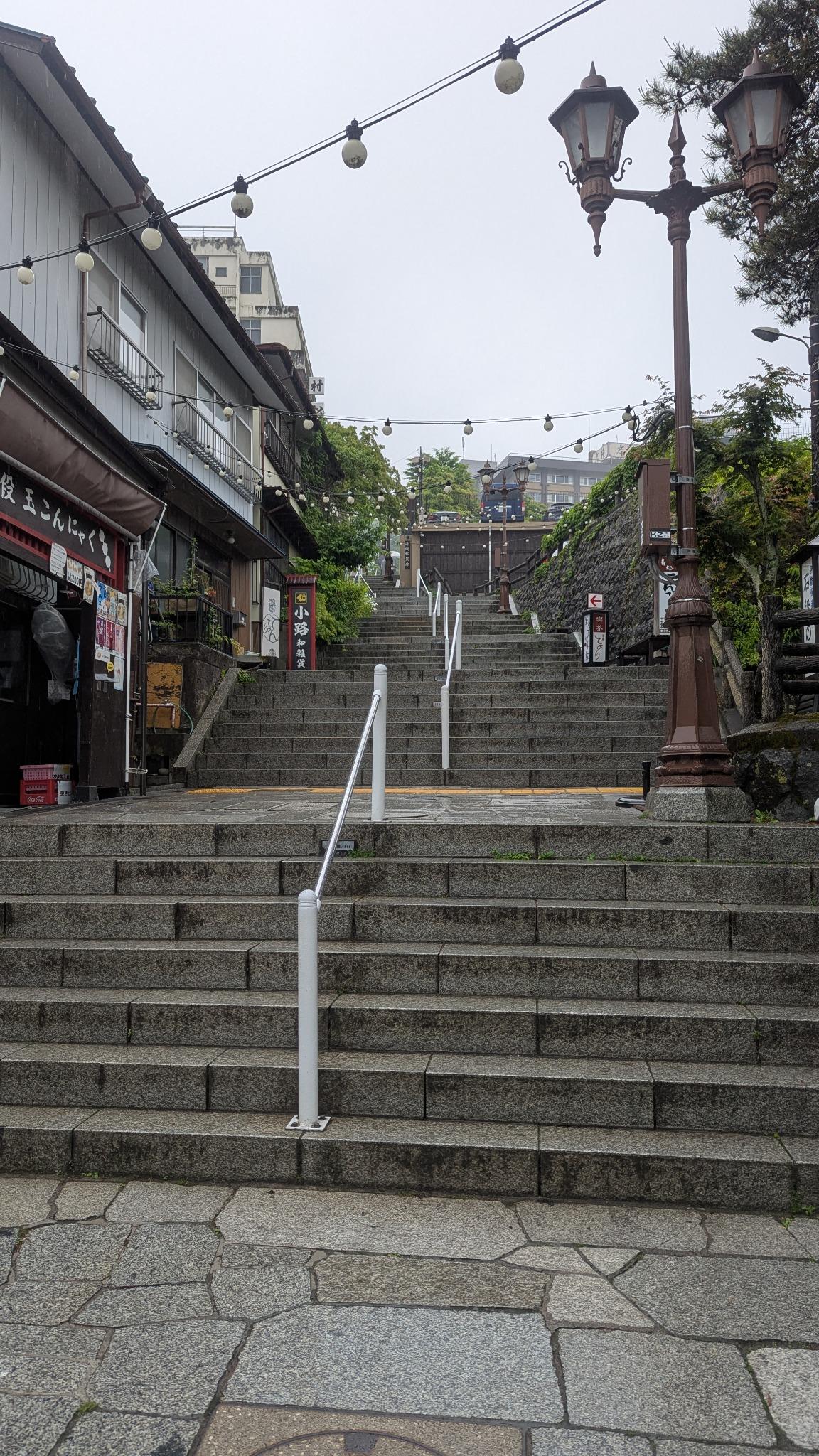
Ikaho’s stone-step street, the defining approach to the shrine.
Quick Facts
Location: Ikaho, Ikaho-machi, Shibukawa, Gunma
Enshrined deities: Onamuchi no Mikoto (also known as Okuninushi) and Sukunahikona no Mikoto
Character: Sits atop Ikaho Onsen’s stone-step street; hot spring town and shrine as a single experience
Time needed: A few minutes for the shrine alone; 1–2 hours combined with a walk through the stone-step street
Difficulty: Many stone steps
Footwear: Walking shoes recommended
Best season: Spring through autumn; watch for snow and ice in winter
Public transit: Relatively easy to reach
Car: Use one of the public parking areas nearby
Goshuin: Sometimes available, depending on whether the shrine office is staffed — check on-site
Who This Guide Is For
• Travelers who want to combine a hot spring visit with a shrine
• Anyone curious about walking a traditional Japanese hot spring town
• People drawn to small shrines closely tied to their local communities rather than large, famous ones
• Visitors curious about how a town and its local religious traditions connect
• Anyone who enjoys a townscape built around a long stone stairway
• Travelers exploring Gunma by public transit
• People who want to experience the surrounding area, not just the shrine itself
Why This Shrine Is Special
Understanding Ikaho Shrine means paying attention to the road that leads to it more than the shrine itself.
At the center of Ikaho Onsen is a long stone stairway, lined on both sides with inns, restaurants, souvenir shops, small stores, and the general atmosphere of an old hot spring town. At first, walking it feels like walking through the town. But climb step by step, and the number of shops thins out, the bustle recedes a little at a time, and eventually a torii gate comes into view.
At the top of the stairs is Ikaho Shrine.
In other words, the hot spring town itself functions as a long approach path to the shrine.
365 Steps Through Town
Ikaho’s stone stairway has 365 steps in total. Markers along the way count off the number, with a sign reading "365 steps" near the very top.
The staircase doesn’t run in a single unbroken line — shops, small plazas, and rest spots appear along the way. Because of that, it feels less like climbing a staircase and more like walking through town while gradually gaining elevation.
In a real sense, the visit to Ikaho Shrine doesn’t begin at the shrine gate — it begins the moment you start climbing the stairs.

Step 365 marks the top of Ikaho’s famous stone-step street.
Where the Town Becomes a Shrine
Near the top of the stairway, a torii gate and the shrine’s name marker come into view. This is where the atmosphere shifts from town to shrine: stone steps, a torii gate, trees, and a steeper staircase continuing beyond it.
The shrine grounds aren’t large. If anything, the impression is of a shrine placed quietly at the natural continuation of the hot spring town — not a grand gate or imposing architecture meant to overwhelm you. Because of that, what stays with you most is the experience of the climb itself.

The final approach to Ikaho Shrine, where the town gives way to a quieter sacred space.
A Small Shrine at the Top of 365 Steps
The shrine hall at Ikaho isn’t large, and the grounds are fairly compact. But after a long climb, arriving at a modest shrine feels entirely natural.
This isn’t the experience of "arriving at an enormous shrine." It’s closer to "walking the length of a hot spring town and meeting the kami of that land at the end of it." The shrine isn’t a separate attraction sitting apart from the town — it sits at the very top of it.
Hot Springs and the Shrine
It’s difficult to fully separate Ikaho’s hot springs from its shrine.
Ikaho Onsen has long been known as a toji destination — a place for hot-spring healing and recovery. A hot spring is a place to rest, recover, and stay for a while.
Ikaho Shrine enshrines Onamuchi no Mikoto and Sukunahikona no Mikoto — two deities associated in Japanese mythology with nation-building, medicine, and healing. The connection between a hot spring town built around physical recovery and deities tied to health and healing is one of the clearest, most intuitive ways to understand this particular place.
With the shrine positioned above the town, hot spring culture and religious culture don’t read as two separate things here — they overlap within the same stretch of land.
Brief History and Background
Ikaho Shrine has long been connected to local religious traditions. Its origins are tied to the surrounding mountains and natural landscape, and over time that local worship became closely intertwined with the development of the hot spring town itself.
Today’s Ikaho Shrine isn’t a shrine placed here later purely for tourism. It represents a place where mountain-based worship and hot-spring culture have overlapped over a long stretch of time.
You don’t need to know exact dates or institutional history to understand the point that matters most: this shrine and this hot spring town have long been connected to the same landscape.
Small — and That’s the Point
Ikaho Shrine isn’t a mountain shrine surrounded by boulders and waterfalls, like Haruna Shrine. It isn’t a shrine with an ornate hall at the top of a dramatic staircase, like Myogi Shrine. Its grounds are modest, and its architecture is understated.
That’s exactly what suits it. The real subject here isn’t the shrine on its own — it’s the continuous flow from town, to staircase, to torii, to shrine. That sequence is what makes visiting Ikaho Shrine feel the way it does.

The shrine hall is modest in scale — a quiet destination after the long climb through town.
Smaller Shrines on the Grounds
The grounds also include a few small shrines. Paying attention to these quieter places of prayer, rather than only the main hall, gives a better sense of what a locally rooted shrine actually feels like.
Ikaho Shrine sits within a heavily visited hot spring town, but the shrine grounds themselves aren’t a flashy tourist facility. That quietness stands in clear contrast to the liveliness of the stone-step street below.

One of the small shrines within the grounds.
Ikaho on a Rainy Day
On a rainy day, the stone steps grow slick, the rooftops darken with rain, and the greenery looks deeper and more saturated. Climbing with an umbrella takes a little more effort than on a clear day.
But a rain-soaked stone-step street and its old buildings suit Ikaho well. By the time you reach the shrine, the sounds of the town have faded a little, and the sound of rain often takes over instead — a quieter, different face of the hot spring town than you’d see on a sunny day.
The Atmosphere
Looking up at the long staircase from the bottom. Walking between the shops. Turning back to look at the view. Reaching step 365. Passing through the torii. Climbing a little farther. Standing in front of the shrine hall.
It’s this entire sequence — not any single moment — that stays with you.
Praying here is really an extension of walking through town.
That’s the defining feature of a visit to Ikaho Shrine.
How to Behave Respectfully
Standard shrine etiquette applies: bow at the torii, purify your hands and mouth at the temizuya if available, and pray at the main hall. See our full guide, Shrine Etiquette in Japan, for details.
At Ikaho Shrine specifically, pay attention to the stairs. With 365 steps in total:
• Take it slow if you have any difficulty with stairs.
• Steps can be slippery when wet.
• Watch for snow and ice in winter.
There are places to rest partway up the stairway, so there’s no need to rush.
Goshuin
Ikaho Shrine may offer a goshuin depending on whether the shrine office is staffed at the time of your visit — it isn’t guaranteed to be available. If receiving one matters to your visit, check the shrine office’s status once you arrive.
For a full explanation of how goshuin work, see our companion guide, What Is a Goshuin?
How to Visit
Ikaho Shrine sits at the top of Ikaho Onsen’s stone-step street, in Ikaho, Ikaho-machi, Shibukawa, Gunma.
By public transit: Take a bus from Shibukawa Station toward Ikaho Onsen, get off near the stone-step street, and walk up from there. Compared with many shrines in Gunma’s mountain areas, Ikaho Onsen is relatively easy to reach without a car.
By car: Use one of the public parking areas around Ikaho Onsen and walk to the stone-step street from there. Ikaho Shrine works best as part of a broader visit to Ikaho Onsen rather than as a standalone destination.
Difficulty and Walkability
Ikaho Shrine isn’t a mountain shrine, but its 365 stone steps mean it takes more effort than a shrine on flat ground. Sneakers or walking shoes are recommended.
Rest spots are built into the stairway along the way, so there’s no need to hurry. Take your time and enjoy the town as you climb.
Best Time to Visit
Spring–early summer — Fresh greenery and comfortable walking conditions.
Summer — The climb can get warm; bring water.
Autumn — Fall foliage pairs well with a walk through the hot spring town.
Winter — A wonderful season for the hot springs themselves, but watch for snow and icy steps.
Practical Notes for Foreign Visitors
• Time needed: A few minutes for the shrine alone; 1–2 hours combined with the stone-step street.
• Footwear: Walking shoes are worth packing.
• Steps: 365 in total.
• Rain: Wet stone steps can be slippery.
• Winter: Watch for snow and ice.
• Public transit: Compared with many shrines in Gunma’s mountain areas, this is one of the easier ones to visit without a car.
• Car: Use the public parking areas nearby.
• Goshuin: Availability depends on the shrine office — check on-site.
• The town itself: Worth walking as part of the visit, not just the shrine.
Final Thoughts
What stays with you at Ikaho Shrine isn’t a large shrine hall or elaborate carving. It’s the town itself, on the way there.
Looking up at the stairway from the bottom of the hot spring town. Climbing one step at a time. Passing shops, glancing at the view behind you. Crossing step 365. Passing through the torii. Then, at last, the shrine.
Ikaho Shrine might be best understood not as a shrine located within a hot spring town, but as a shrine at the end of walking that town, from bottom to top.
Seeing the shrine, walking the hot spring town, and climbing the stairs are really one continuous experience. That’s what makes a visit to Ikaho Shrine worthwhile.
Author’s Note
This guide is based on a visit to Ikaho Shrine and the Ikaho Onsen stone-step street in May 2026, including firsthand observation of the stairway, the 365th step, the torii gate, the shrine hall, the grounds, and conditions on a rainy day.
Historical and religious details have been checked against official information and regional sources where available.
Japanese travel notes: More firsthand shrine visits and original Japanese-language articles are available on note.