Last updated: September 2026
Karasawayama Shrine sits atop Mount Karasawa in Sano, Tochigi Prefecture.
It is best known for the cats that live across its grounds. But walk farther into the mountain, and it becomes clear there is considerably more to the shrine than that.
Moss-covered stone walls. A large well dating back to its castle-era past. A shrine dedicated to a dragon deity. Stone steps disappearing into deep green. And, from the summit, a sweeping view across the Kanto Plain.
The shrine stands on the former main enclosure of Karasawayama Castle, once one of the Kanto region’s most significant mountain fortresses.
During one quiet visit just after rain, a black-and-white cat walked a little way ahead along the approach path — almost as if leading the way toward the shrine deep within the old castle ruins.

Quick Facts
| Name | Karasawayama Shrine |
| Location | 1409 Fujimachi, Sano, Tochigi |
| Character | Shinto shrine / National Historic Site — Karasawayama Castle ruins |
| Enshrined deity | Fujiwara no Hidesato |
| Founded | 1883 (Meiji 16) |
| Main highlights | Cats, castle stone walls, the Oi well, Ryujingu, Wago Inari Shrine, views across the Kanto Plain |
| Time needed | About 60–90 minutes |
| Admission | Free to visit the grounds |
| Access | Car, or taxi from the nearest station |
If you’re hoping to receive a goshuin or amulets, it’s worth checking reception hours on the shrine’s official website before you go.
Who This Guide Is For
- Anyone hoping to encounter cats at a quiet mountain shrine
- Travelers who want to experience a shrine and a castle ruin in a single visit
- Anyone interested in regional history beyond the well-known tourist circuit
- Visitors who enjoy forests, stone steps, and the atmosphere after rain
- Anyone who likes to take their time walking the grounds with a camera in hand
The grounds include stone steps and sloped paths that can get slippery after rain — comfortable, non-slip shoes are worth wearing.
Cats aren’t always found in the same spot from one visit to the next. It’s best to think of this less as “a shrine where you’re guaranteed to see cats” and more as a place where a chance encounter with one is part of the experience of walking the castle ruins and shrine grounds.
A Mountain Where Cats Live
On the morning of this visit, Karasawayama Shrine was wrapped in clear mountain air after the rain. The stone steps were wet, the walls were covered in moss, and the trees looked a deeper green. Few other visitors were on the path leading up to the grounds.
A cat was the first presence waiting on the quiet approach.
Standing near the torii gate, it neither retreated nor showed much concern. It seemed almost to be quietly watching over those arriving on the mountain.
This visit to Karasawayama Shrine began with that quiet encounter.

Following a Black-and-White Cat
Farther along the approach, a black-and-white cat began walking a short distance ahead.
It did not hurry away. Keeping a steady distance, it moved slowly toward the stone steps — pausing now and then and glancing back before continuing.
Following behind felt less like simply heading toward a shrine and more like being led deeper into the mountain.
Of course, the cat was probably not acting as a guide. But on a quiet, rain-washed approach with no one else in sight, its place a few steps ahead made it look remarkably as though it were saying, this way.

A Shrine, and a Castle Ruin
The approach to Karasawayama Shrine looks a little different from an ordinary shrine path for a simple reason: this was once a mountain castle.
Karasawayama Castle served as the stronghold of the Sano clan from the medieval period through the Sengoku era. Several traditions, some legendary, describe its origins, but by the Sengoku period it had become one of the Kanto region’s most significant mountain fortresses.
Traces of that history remain today in the terraced enclosures, moats, and stone walls built into the mountain’s steep terrain. The Karasawayama Castle ruins were designated a National Historic Site in 2014, in recognition of their historical value.
The present-day shrine, by contrast, was founded much later, in 1883. According to the shrine’s official history, it was built on the castle’s former main enclosure and dedicated to Fujiwara no Hidesato, regarded as the ancestor of the Sano clan.
In other words, a shrine was built, generations later, on ground already carrying a much older layer of history.
Fujiwara no Hidesato was a warrior of the Heian period, best known for helping suppress the rebellion of Taira no Masakado. He is also known by the name Tawara Toda and appears in legend as the warrior who defeated a giant centipede. Suginomori Shrine, in Tokyo’s Nihonbashi district, has its own tradition that Hidesato prayed there for victory before confronting Masakado’s rebellion.
For more context, see the Sacred Japan guide to Suginomori Shrine.
While walking through Karasawayama Shrine, look beyond the shrine buildings to the stone walls and terrain lining the path. The route followed by visitors today once carried the people who lived in and defended the castle.


The Oi Well: What Kept the Castle Alive
The grounds contain a large well known as the Oi, literally the “Great Well.”
For a castle built near a mountain summit, securing water was a matter of survival. This well is said to have been a vital water source sustaining the people who lived at Karasawayama Castle.
After rain, the surrounding trees reflect off its surface, giving it the look of a quiet forest pond rather than a piece of castle infrastructure.
Remembering that this was once a Sengoku-era castle changes that impression. Stone walls were not the only things that sustained the people here. A reliable source of water made life on the mountain possible. The Oi well is a reminder that Karasawayama Castle was not simply a place of battle, but also a place where people lived.

Mountain, Water, and Dragon Worship
Near the Oi well stands Ryujingu, a shrine dedicated to a dragon deity.
In Japan, dragons have long been closely associated with water and rain. It feels entirely natural that dragon worship would take root here, in a spot on the mountain that holds such an abundant water source.
Seen through the damp air after rain, Ryujingu sits quietly within its surrounding greenery, carrying a distinct presence of its own.
The grounds also include a suikinkutsu — a distinctly Japanese garden feature in which water dripping into a buried cavity produces a clear, harp-like sound.
Flowers floating in the temizuya basin. Rain-soaked plants. The still surface of the well. The sound of the suikinkutsu. At Karasawayama Shrine, the mountain can be experienced not only through sight, but through sound and the dampness of the air.

Layers of Belief on One Mountain

The grounds also include Wago Inari Shrine.
Passing beneath its row of vermilion torii gates set against deep green shifts the atmosphere noticeably from the stone-walled approach that came before.
Karasawayama Shrine, dedicated to Fujiwara no Hidesato. Ryujingu, associated with water. And an Inari shrine that receives prayers connected to daily life and commerce.
Within a short walk through the mountain, distinctly different kinds of belief overlap. Rather than focusing on one large shrine hall, following the smaller shrines, water, stone, and old paths scattered across the grounds reveals the layered history of prayer this mountain has carried forward.
Karasawayama Shrine, on the Former Main Enclosure
Climb to the top of the stone steps, and the shrine hall of Karasawayama Shrine comes into view.
This was once the honmaru — the main enclosure — at the heart of Karasawayama Castle. Where the castle’s command center once stood during the Sengoku period, a shrine dedicated to Fujiwara no Hidesato now stands.
Just after rain, the shrine hall carries both the strength of a former mountain fortress and the quiet of a forest shrine, side by side.
The atmosphere invites quiet reflection rather than urgent requests: a moment to become still, settle one’s footing, and consider where one stands.
That kind of stillness suits a shrine set on the ruins of a mountain castle particularly well.

The Cats Living on the Grounds
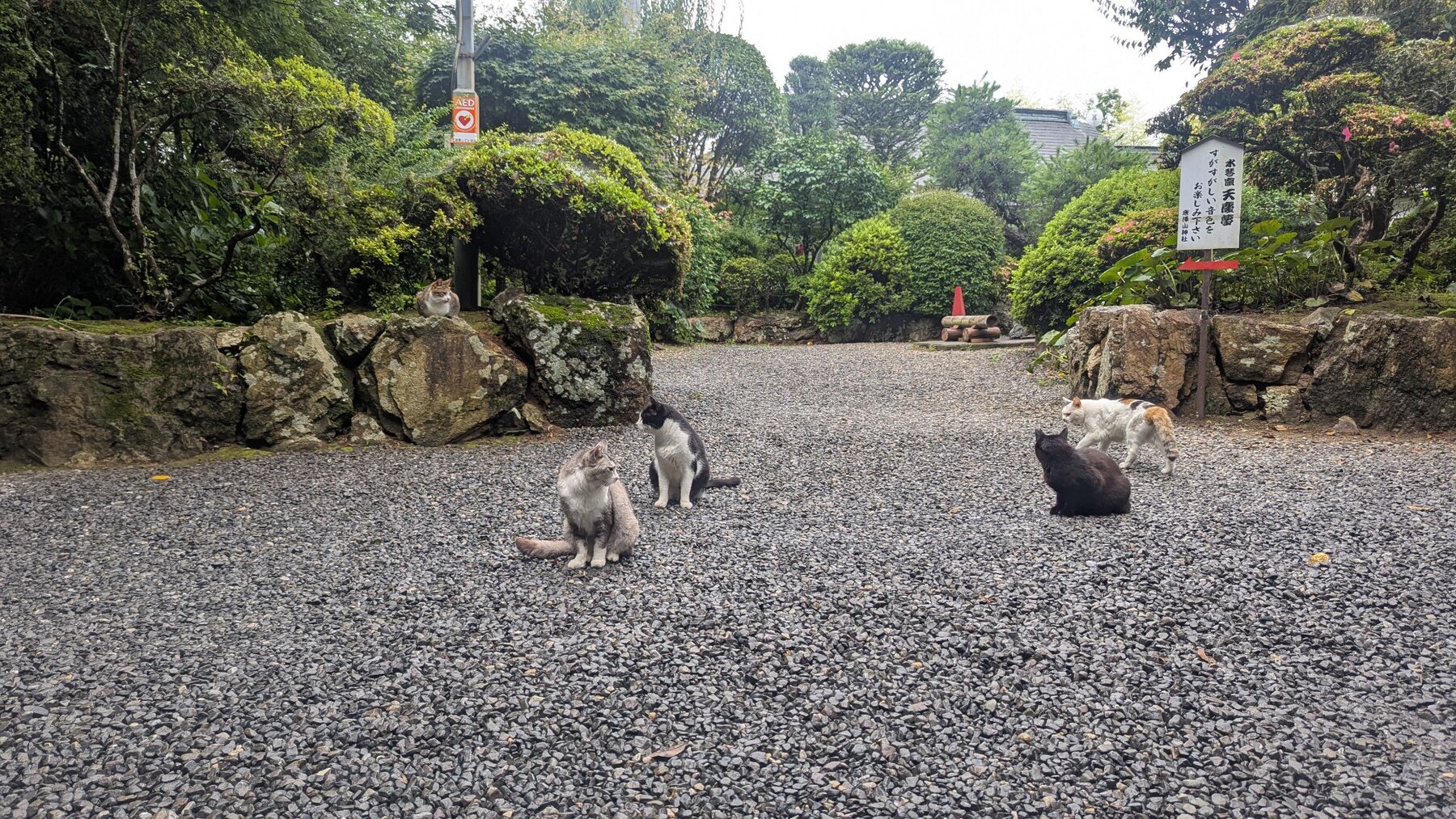
Cats live in various parts of the approach and shrine grounds.
During this visit, one sat on a rock, another rested in the shade, and another watched from the gravel path. Elsewhere, small groups gathered together, each cat going about its own business.
They neither sought attention nor kept entirely out of sight. They simply appeared at home on the mountain.
Their presence adds an unexpected softness to the otherwise weighty atmosphere of a castle ruin.
That said, this isn’t a cat café or a zoo — it’s a place where these cats live their daily lives. Avoid chasing or handling them, and observe quietly instead. Follow local guidance or the shrine’s own policy regarding feeding, rather than deciding on your own.
Cats may also be found near or under parked cars, or close to the road. Check around your vehicle before pulling out of the parking area, and drive carefully on the mountain road as well.

A View Over Sano From the Summit
From near the shrine hall, the town of Sano and the Kanto Plain spread out below.
Even on a day with lingering clouds after rain, clear air can reveal the townscape stretching out into the distance.
Taking in this view, it becomes easier to understand why a castle was built here in the first place: a high vantage point to watch for the movement of people or troops, and terrain steep enough to serve as natural defense in its own right.
The view alone explains a great deal about why Karasawayama Castle remained such an important stronghold for so long. From here, visitors can also imagine the same landscape once watched by those responsible for defending the surrounding territory — one of the distinctive experiences of visiting Karasawayama Shrine.

How to Behave Respectfully
Karasawayama Shrine is both a place people visit and a place of active, ongoing worship.
- Pause and bow lightly at the torii gate
- Avoid the center of the approach path, and be mindful of other visitors
- Purify your hands at the temizuya if available, before praying
- The standard shrine prayer sequence is two bows, two claps, and one final bow
- Keep your voice down and limit lengthy photography near the shrine hall
- Follow posted signage regarding photography inside buildings or during ceremonies
- Don’t chase or handle the cats
- Don’t climb on the castle’s stone walls or remaining structures
- Take your trash with you
You don’t need to have every detail of etiquette memorized — quiet, respectful behavior is what matters most.
How to Visit
By car: According to the Sano Tourism Association, travel times from nearby interchanges are as follows:
- About 10 minutes from the Sano-Tanuma IC on the Kita-Kanto Expressway
- About 20–21 minutes from the Sano-Fujioka IC on the Tohoku Expressway
- Parking is available; the shrine hall is about a 10-minute walk from the parking area
You can drive most of the way up the mountain, but expect stretches with limited visibility around curves. Slow down after rain or around dusk, and watch for oncoming vehicles and wildlife.
By train: From Sano Station (JR Ryomo Line / Tobu Sano Line), the taxi ride takes about 18–20 minutes. From Tanuma Station (Tobu Sano Line), it takes about 7–10 minutes.
This isn’t a shrine you can casually reach on foot from the station, so a car or taxi is the realistic option. If relying on a taxi for the return trip, it’s worth confirming how to arrange one in advance, since taxis may not be readily available on-site.
Transit details and reception hours can change — check the shrine’s official website for current information before visiting.
Visiting Tips
Time needed: About 60 minutes to cover the main sites. Allow around 90 minutes if you want to spend time looking for cats or taking in the castle ruins and the view at a relaxed pace.
What to wear: The grounds include stone steps and sloped paths — sneakers or other non-slip, comfortable shoes are recommended.
Visiting after rain: Wet stone steps and moss can be slippery, so take care underfoot. At the same time, the greenery deepens after rain, making the grounds’ water features and stone walls especially striking.
Meeting the cats: Their presence and location shift with the weather and time of day. There’s no guarantee of seeing one, so it’s best to walk the grounds quietly and enjoy the possibility of a chance encounter.
Author’s Note
My visit to Karasawayama Shrine began with a cat waiting near the torii gate.
Further along, a black-and-white cat walked a little ahead of me, pausing now and then as if checking that I was still following, before continuing toward the stone steps.
I cannot say for certain that it was really guiding me. But on a rain-washed approach with no one else in sight, the way it walked just ahead looked unmistakably as though it were saying, this way.
What followed that cat led to far more than an encounter with some charming animals. Castle-era stone walls. The well that once sustained the castle’s residents. Ryujingu, still carrying the presence of water. A row of vermilion torii leading to an Inari shrine. The shrine hall standing on the former main enclosure. And, from the summit, a view stretching across the Kanto Plain.
At Karasawayama Shrine, history, belief, nature, and the daily lives of its resident cats all overlap within a single mountain. That day felt less like visiting a shrine, and more like being welcomed into Mount Karasawa itself.
Visitors who come for the cats may well leave having felt something else entirely: the quiet, watchful history layered into this mountain over a very long time.
Leave a Reply