Last updated: September 2026
In Chichibu, Saitama Prefecture, the road climbs further and further from town, winding higher into the mountains until it reaches Mitsumine Shrine — set at roughly 1,100 meters above sea level.
This isn’t simply "a well-known shrine that happens to be in the mountains." What defines Mitsumine Shrine is mountain worship, combined with something rarer: reverence for the wolf as a messenger of the kami.
The difference is obvious from the moment you arrive. Where most shrines place guardian lion-dogs (komainu) beside the torii, Mitsumine Shrine has wolves instead — lean bodies, long muzzles, sharp ears, standing watch over visitors.
Deep forest. Massive cedar trees. A mountainside setting. A shrine hall in vivid color. And further still, an inner shrine deep in the mountains beyond.
At Mitsumine Shrine, the buildings alone don’t tell the full story. The shrine, the mountain, and the wolf tradition function as a single, connected world — and that connection is the shrine’s greatest appeal.
Quick Facts
Location
Mitsumine, Chichibu, Saitama
Elevation
Approximately 1,100 meters
Enshrined deities
Izanagi no Mikoto and Izanami no Mikoto
Character
Wolf-veneration tradition, mountain worship, a triple torii gate, vividly colored shrine architecture, the Okariya shrine, and an inner shrine (Okumiya)
Divine messenger
The wolf (goken’zoku, known as Okuchi no Magami)
Time needed
1.5–2 hours
Access
Bus from around Seibu-Chichibu Station, or by car
Difficulty
Slopes and stairs throughout the grounds
Best for
Mountain worship, Japan’s wolf-veneration tradition, and the relationship between nature and shrines
Winter
Snow and icy roads are a real concern — plan carefully
Who This Guide Is For
- Anyone interested in Japanese mountain worship
- Travelers curious about a culture that venerates the wolf as a messenger of the kami
- Anyone looking for a shrine that feels completely different from an urban one
- Visitors who want to experience a shrine as part of its forest and mountain, not separate from them
- People who appreciate both architecture and nature in the same visit
- Travelers planning to spend a full day exploring Chichibu
This isn’t a shrine you casually stop by on the way to somewhere else near Tokyo. It’s better approached as a destination where the journey itself is part of the experience.
Why This Shrine Is Special: A Shrine Guarded by Wolves

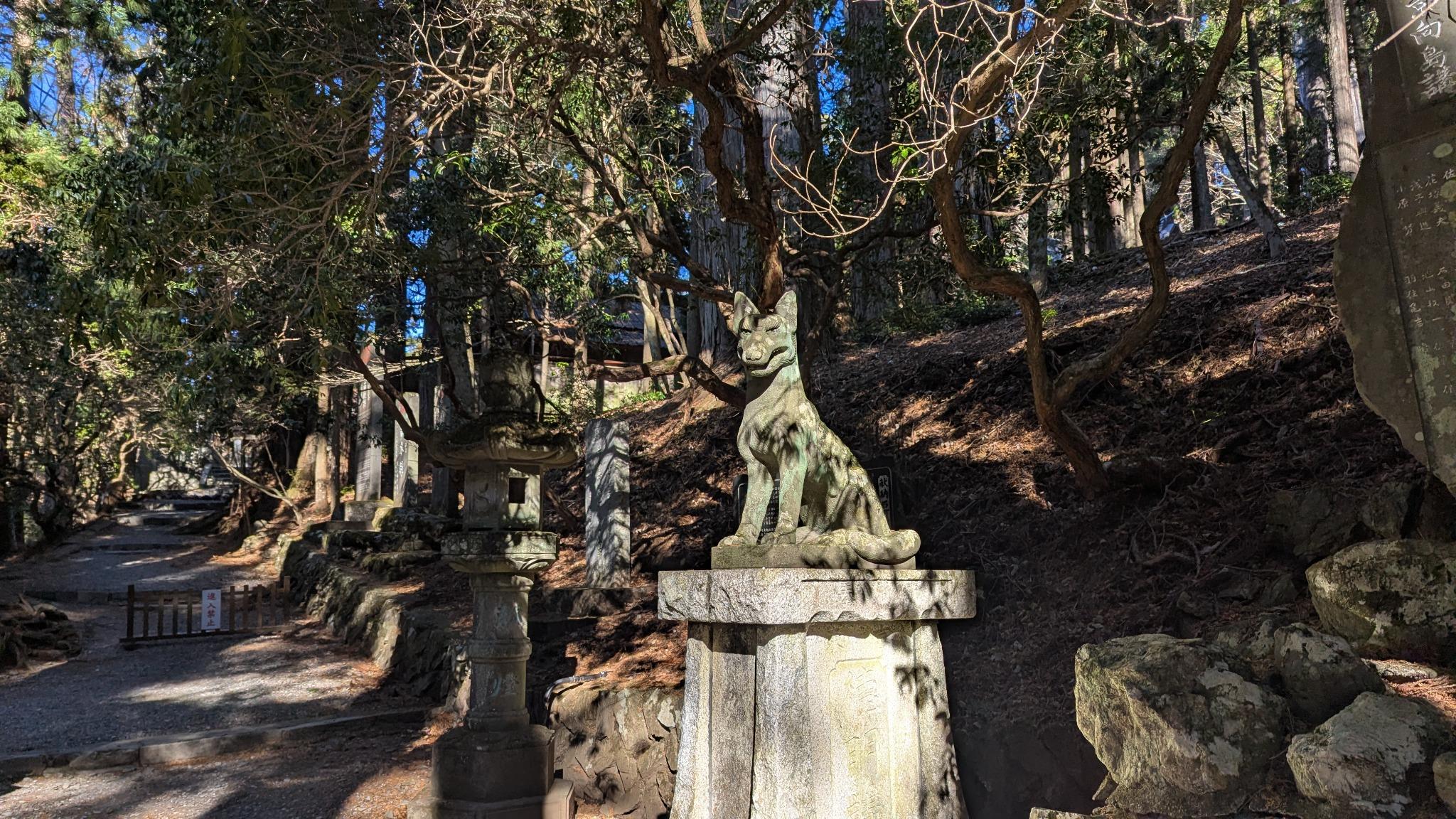
A wolf guardian on the forested approach — a visible expression of Mitsumine Shrine’s goken’zoku tradition.
The most striking feature at Mitsumine Shrine is the wolf.
Most Japanese shrines place guardian komainu statues at the entrance. At Mitsumine Shrine, wolves fill that role instead.
Here, wolves are venerated as goken’zoku — attendants in service to the kami. As animals of the mountains, wolves have long been seen by people as both fearsome and uniquely knowledgeable about the deep mountain interior. At Mitsumine Shrine, the wolf isn’t understood as a bringer of misfortune, but as a protector that shields people from it.
Okuchi no Magami: Between "Wolf" and "Messenger of the Kami"
Central to the wolf tradition at Mitsumine Shrine is a name: Okuchi no Magami (大口真神).
It would be a bit of a misreading to think of this simply as "the wolf itself worshipped as a deity." At Mitsumine Shrine, the wolf is understood as a goken’zoku — an attendant that carries the kami’s will and offers protection to people, having received the kami’s spiritual power and acting with it.
The tradition traces back to a founding legend: according to the shrine, Yamato Takeru no Mikoto, the legendary prince credited with establishing the shrine, was guided through these mountains by a wolf. In recognition of the wolf’s courage and loyalty, it was named a messenger of the kami. Since then, Okuchi no Magami — also known by names like Oinu-sama ("honorable dog") — has long been venerated for protection from fire, theft, and various misfortunes.
An animal of the deep mountains becoming a protector of the human world is a genuinely interesting example of how nature is understood within Japanese belief.
The Triple Torii: An Entrance Unlike Any Other

The distinctive triple torii marks the entrance to Mitsumine Shrine, with wolf guardians standing on either side.
The entrance to Mitsumine Shrine features a distinctive triple torii (mitsu-torii) — a large central gate flanked by two smaller ones, forming what looks like one gate with three separate openings.
Wolf statues stand on either side.
Passing through it alone makes clear that Mitsumine Shrine isn’t an ordinary neighborhood shrine. What lies beyond isn’t a building — it’s mountain and forest. The gate reads less like a simple entrance and more like a boundary between the everyday world and a mountain sanctuary.
Walking Through the Forest

The approach path continues through deep forest before the main shrine buildings come into view.
Beyond the torii, the approach path continues into the forest: tall cedar trees, a mountainside slope, stone retaining walls, old lanterns, and the occasional wolf statue along the way.
The shrine hall isn’t visible right away. There’s a stretch of forest to walk through first — and that stretch matters. It’s possible to drive or take a bus most of the way up the mountain, but once inside the shrine grounds, there’s still a stretch that has to be covered on foot, through the forest.
Walking through that forest before the shrine hall comes into view is what gives the eventual arrival its weight — a genuine sense of "I made it here."
Mountain Worship and Mitsumine Shrine
Shrine tradition holds that Mitsumine Shrine was founded by Yamato Takeru no Mikoto. The region has also long been closely associated with Shugendo, the tradition of mountain ascetic practice — according to the shrine, the ascetic En no Ozunu is said to have practiced in these mountains during the reign of Emperor Monmu, marking what’s believed to be the beginning of Shugendo practice here. In later centuries, the shrine went on to serve as a major regional center for Tendai-affiliated mountain asceticism.
In Japan, high mountains, deep forests, rocks, waterfalls, and places difficult for people to reach have often been regarded as sacred. Mitsumine Shrine sits firmly within that tradition of mountain worship.
What matters here isn’t simply that a shrine happens to sit on a mountain. It’s that the mountain itself is an essential part of understanding the belief.
The Shrine Hall, Revealed at the Top of the Stairs

Stone steps rise toward the main shrine complex, where wolf figures replace the more familiar komainu.
Continue along the forest path and climb a set of stone steps, and the shrine hall finally comes into view — a moment that shifts the entire impression of Mitsumine Shrine.
Up to this point, the surroundings have been earth-toned: brown, green, gray, the colors of nature. The shrine hall, by contrast, is strikingly vivid — red, blue, green, gold. Set deep in the mountains, that color feels even more intense than it might elsewhere.
The Worship Hall: A Burst of Color Deep in the Mountains

Vivid carving and color stand out against the dark cedar forest surrounding the worship hall.
Mitsumine Shrine’s worship hall is heavily decorated: finely carved beams and pillars, vivid coloring, gold ornamentation, motifs of dragons and plants. Examined closely, it’s genuinely ornate.
Even so, the grounds as a whole never feel gaudy — largely because the massive cedars and the surrounding mountain hold the whole scene in check. An elaborately decorated, human-made structure, set within an overwhelming natural landscape: that contrast defines the character of Mitsumine Shrine.
Massive Cedars and the Shrine Hall
Enormous trees surround the worship hall. Photographing the building alone doesn’t quite convey the scale of this place — seeing it alongside the trees does.
The shrine hall itself is large and richly decorated. And yet the trunks of the cedars still look larger. At Mitsumine Shrine, the architecture doesn’t dominate nature — it feels more like one more presence, placed within the mountain itself.
Okariya: The Clearest Place to Experience the Wolf Tradition

The entrance to Okariya, the temporary dwelling where the shrine’s wolf goken’zoku are venerated.
If you visit Mitsumine Shrine, make a point of seeing Okariya.
This is where the shrine’s goken’zoku — the wolf — is enshrined. The name okariya ("temporary dwelling") reflects the idea that, since wolves are believed to live deep in the mountains, this structure serves as their temporary home for worship purposes.
The path to Okariya carries an even stronger mountain atmosphere than the area around the main hall: stone steps, forest, rock, and wolves. This is one of the clearest places to understand why Mitsumine Shrine is known as a shrine of wolf worship.
Why the Wolf Became a Guardian
Today, the wolf tends to carry an image of a fearsome wild animal. In Japan’s mountain regions, though, there was another way of seeing it.
The wolf lived deep in the mountains, knew the terrain better than any person could, and was known to chase off animals that damaged farmland. Feared and respected at the same time.
In Japanese nature worship, a being that’s powerful precisely because it’s frightening can come to be revered as a protector rather than simply feared. The wolf tradition at Mitsumine Shrine is a distinctive example of that way of relating to nature.
Okumiya: The Shrine Continues Deeper Into the Mountains
Mitsumine Shrine isn’t limited to its main hall — it also has an Okumiya, an inner shrine, located near the summit of Mount Myohogatake.
Reaching it means continuing on mountain trails well beyond the main shrine grounds. In other words, what most visitors see is not the entirety of Mitsumine’s tradition — the sacred space continues much further into the mountains.
That structure alone says a great deal about the nature of mountain worship here.
Okumiya Yohaiden: Paying Respects to the Mountain, Even If You Can’t Climb It

Okumiya Yohaiden faces the mountains, allowing visitors to pay respects toward the distant inner shrine.
You don’t need to climb all the way to Okumiya to take part in that tradition. Near the main shrine stands the Okumiya Yohaiden — a hall built specifically for worshipping the distant Okumiya from afar.
From here, the view opens onto the mountains of Chichibu: ridgelines layered one behind another, valleys, almost no trace of human structures. Standing here makes clear, in a way words can’t quite capture, just how high in the mountains Mitsumine Shrine actually sits.
And it reveals something important: what you’re praying toward isn’t only the shrine hall in front of you. It’s a distant mountain. Somewhere beyond it. A place you can’t see. Directing prayer toward that unseen place is one expression of mountain worship itself.
Looking at the Mountains Is Part of the Visit

The mountains of Chichibu seen from the shrine area — not merely scenery, but part of the sacred landscape.
The view from Okumiya Yohaiden is striking enough on its own to be worth the stop. But it’s worth treating it as more than scenery.
Looking at the mountains and holding the thought — "there’s a sacred place somewhere out there, too" — changes what the view means. At Mitsumine Shrine, simply looking toward the mountains becomes an extension of prayer. That’s part of what makes this shrine worth visiting.
The Enshrined Deities
Mitsumine Shrine’s principal deities are Izanagi no Mikoto and Izanami no Mikoto — figures credited in Japanese mythology with creating the Japanese archipelago and giving rise to many of its kami.
There’s no need to go deep into the mythology here. For a visitor, it’s enough to understand them as two of the most significant creator deities in Japanese mythology.
How to Behave Respectfully
No special etiquette is required beyond the standard shrine practices: bow lightly at the torii, purify your hands and mouth at the temizuya if available, and pray at the worship hall. (See our full guide, Shrine Etiquette in Japan, for details.)
Because this is a mountain shrine, pay attention to the approach path and natural surroundings, not just the buildings. The wolf statues here aren’t tourist mascots — treat them with the same respect you’d give any element of the shrine’s living tradition.
Goshuin and Amulets
Mitsumine Shrine offers goshuin and a range of amulets, including some specifically connected to the wolf tradition. These aren’t simply "wolf merchandise" — they’re tied to the belief in protection offered by the goken’zoku. It’s worth checking reception hours locally or on the official website before your visit.
For a full explanation of how goshuin work, see our companion guide, What Is a Goshuin?.
How to Visit
Mitsumine Shrine is located in the mountains of Chichibu, Saitama.
By public transit: Buses run from around Seibu-Chichibu Station toward Mitsumine Shrine. This isn’t a shrine you reach a few minutes after stepping off a train — even by bus, it’s a long ride through mountain roads.
By car: Also involves driving through mountain roads from central Chichibu.
At Mitsumine Shrine, it helps to think of getting there as part of the experience itself, rather than a simple commute to a destination.
Time Needed and Walkability
Visiting the shrine grounds alone takes roughly 1.5–2 hours if you allow yourself time to see things properly: the triple torii, the approach, the worship hall, Okariya, and Okumiya Yohaiden. This isn’t a shrine to rush through.
Expect slopes and stone steps throughout the grounds. It isn’t full-scale mountain hiking, but walking shoes are strongly recommended.
Climbing to the actual Okumiya is a separate undertaking entirely — it involves a genuine mountain trail and should be planned as a distinct trip from a standard visit to the main shrine.
Best Time to Visit
Because of its elevation, Mitsumine Shrine runs noticeably cooler than the city below, and its seasons don’t quite match lowland timing.
Spring — Arrives later here than at lower elevations. Fresh greenery makes for a beautiful walk through the forest.
Summer — Often cooler than the lowlands, though mountain weather can shift quickly — pack rain gear.
Autumn — A rewarding season for mountain scenery. Fall foliage can bring crowds, so allow extra time.
Winter — Requires special attention (see below).
Winter: A Season That Needs Real Preparation
Winter at Mitsumine Shrine calls for more advance planning than any other season.
At roughly 1,100 meters, snow and icy roads can affect the area around the shrine even when Chichibu’s town center is completely clear. Driving may require winter tires or chains. The mountain road leading up to the shrine has plenty of curves, and shaded sections can stay icy well after a storm has passed. If you’re not confident driving on snow or ice, it’s better not to risk it.
Public transit schedules can also be affected by snow or severe weather.
On the grounds themselves, stone steps, slopes, and shaded areas can become slippery. Non-slip footwear, warm clothing, and gloves are all worth packing for a winter visit.
Conditions for reaching Okumiya are entirely different in winter from a standard visit to the main shrine — check current trail and weather conditions carefully, and don’t push through if conditions look unsafe.
This isn’t a shrine to approach with the same mindset as a shrine closer to Tokyo in winter.
Practical Notes for Foreign Visitors
- Time needed: About 1.5–2 hours.
- Elevation: Roughly 1,100 meters.
- Highlights not to miss: The triple torii, the wolf statues, the worship hall, Okariya, and Okumiya Yohaiden.
- Walkability: Slopes and stairs throughout.
- Footwear: Walking shoes recommended.
- Public transit: Bus access available — check schedules and travel time in advance.
- Car: Requires driving on mountain roads.
- Winter: Requires special caution — snow and icy roads are a real possibility.
- Winter driving: Confirm winter tires or chains are appropriate for conditions.
- Winter footwear: Non-slip shoes recommended.
- Okumiya: A genuine mountain trail — plan it as a separate trip from the main shrine visit.
- Winter Okumiya trips: Don’t push your limits — check current conditions first.
- Wildlife: A real consideration here. In June 2026, the shrine issued a warning after a bear was sighted along the Okumiya trail. Avoid hiking the trail alone, and use particular caution in early morning and evening hours — check the shrine’s official site for the latest advisories before heading out.
- Photography: Be mindful of anyone in the middle of prayer.
- Timing: Plan to finish your visit with plenty of daylight to spare.
Final Thoughts
What stays with you after visiting Mitsumine Shrine isn’t any single building. It’s the triple torii, the wolves, the deep forest, the stone steps, the vividly colored worship hall, the massive cedars, Okariya, and the mountains of Chichibu stretching out in the distance — all connected into a single space of belief.
At Mitsumine Shrine, the wolf is never just a wild animal. The mountain is never just a backdrop. And sacredness was never confined to the shrine hall alone.
The wolf stands at the boundary between the human world and the world of the mountain — and beyond that boundary lies the sacred mountain itself.
Mitsumine Shrine is best understood not as "a shrine located in the mountains," but as a shrine that exists within a wider sacred landscape shaped by the mountain itself.
And standing at Okumiya Yohaiden, looking out at the mountains beyond, it becomes just a little easier to understand why this shrine exists exactly where it does.
Author’s Note
This guide is based on a firsthand visit to Mitsumine Shrine, including observation of the triple torii, wolf statues, approach path, worship hall, Okariya, Okumiya Yohaiden, and the surrounding mountains. Details on the wolf tradition, the enshrined deities, the founding legend, the shrine’s connection to Shugendo, Okariya, and Okumiya have been cross-checked against the shrine’s official information.
Japanese travel notes: More firsthand shrine visits and original Japanese-language articles are available on note.